Working with AI: Lessons from software’s head start

On Monday, October 26, I gave this talk at a dinner hosted by With Coverage. It explores parallels between AI adoption in software engineering and financial knowledge work, using Excel as finance’s equivalent of the IDE to map four stages: AI assists, collaborates, executes, and coordinates. These are broad generalizations, but software’s head start offers useful clues about where non-programming knowledge work workflows may be headed and how to prepare as an individual and organization.

View in Google Slides · Download the PDF

Select any slide to view it at full size.
Working with AI: Lessons from software’s head start. Title slide, October 2026.
Slide 1 of 26
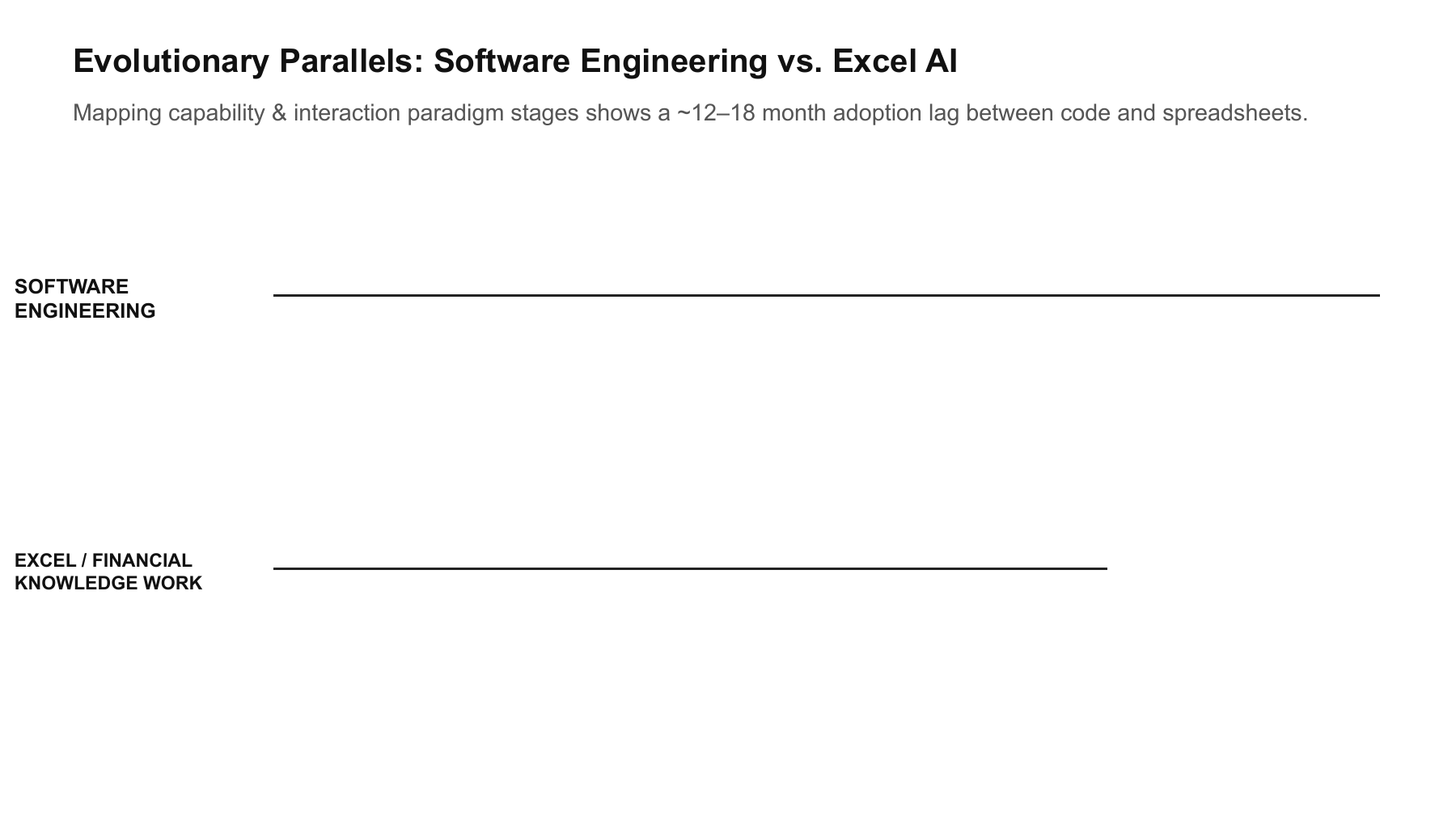
Parallel timelines for software engineering and financial knowledge work introduce the deck’s estimated 12–18 month adoption lag.
Slide 2 of 26
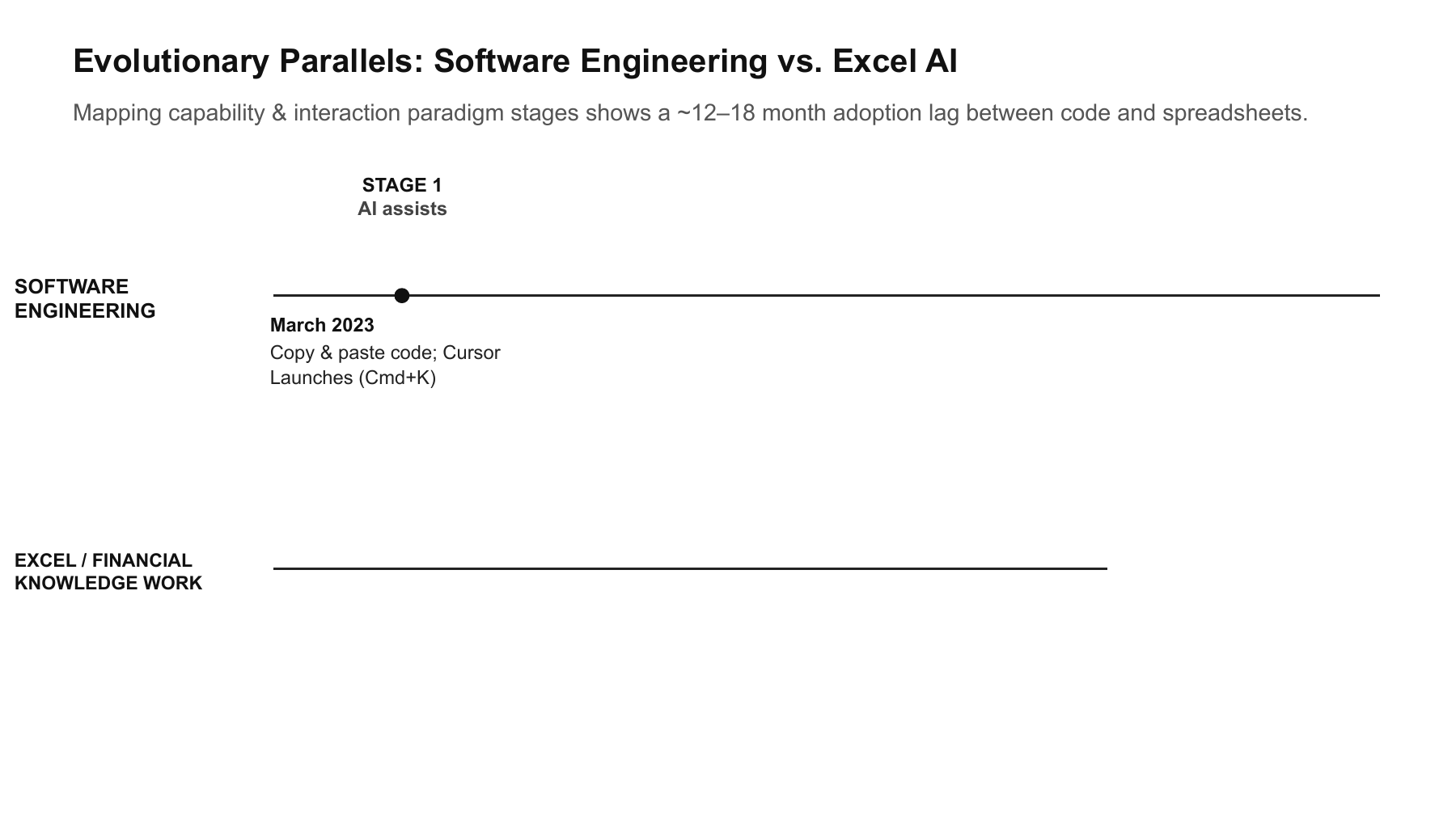
Timeline adds stage 1, AI assists: copying code and Cursor’s March 2023 launch.
Slide 3 of 26
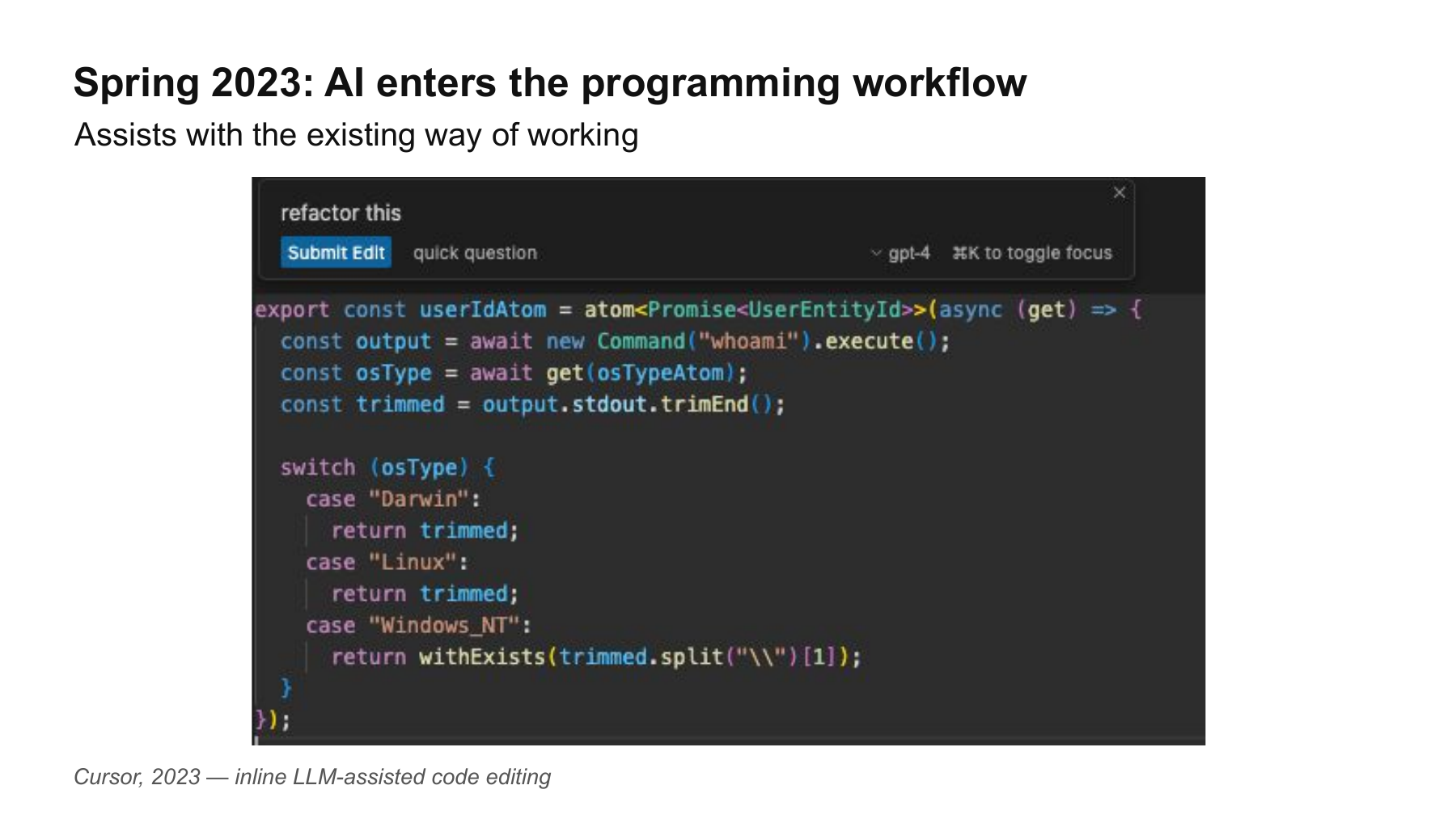
Spring 2023: Cursor’s inline code editing illustrates AI assisting within the existing programming workflow.
Slide 4 of 26
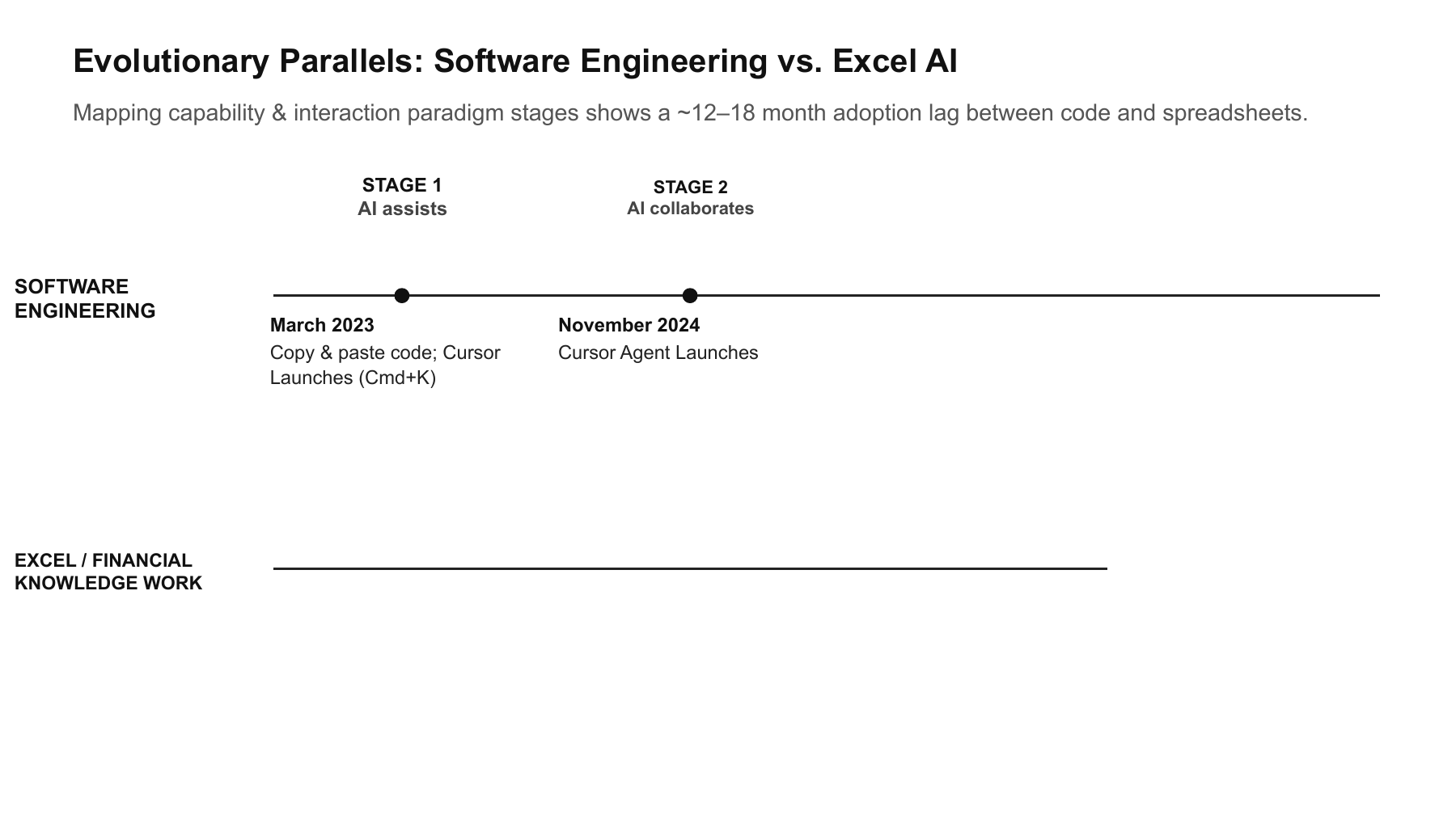
Timeline adds stage 2, AI collaborates: Cursor Agent launches in November 2024.
Slide 5 of 26
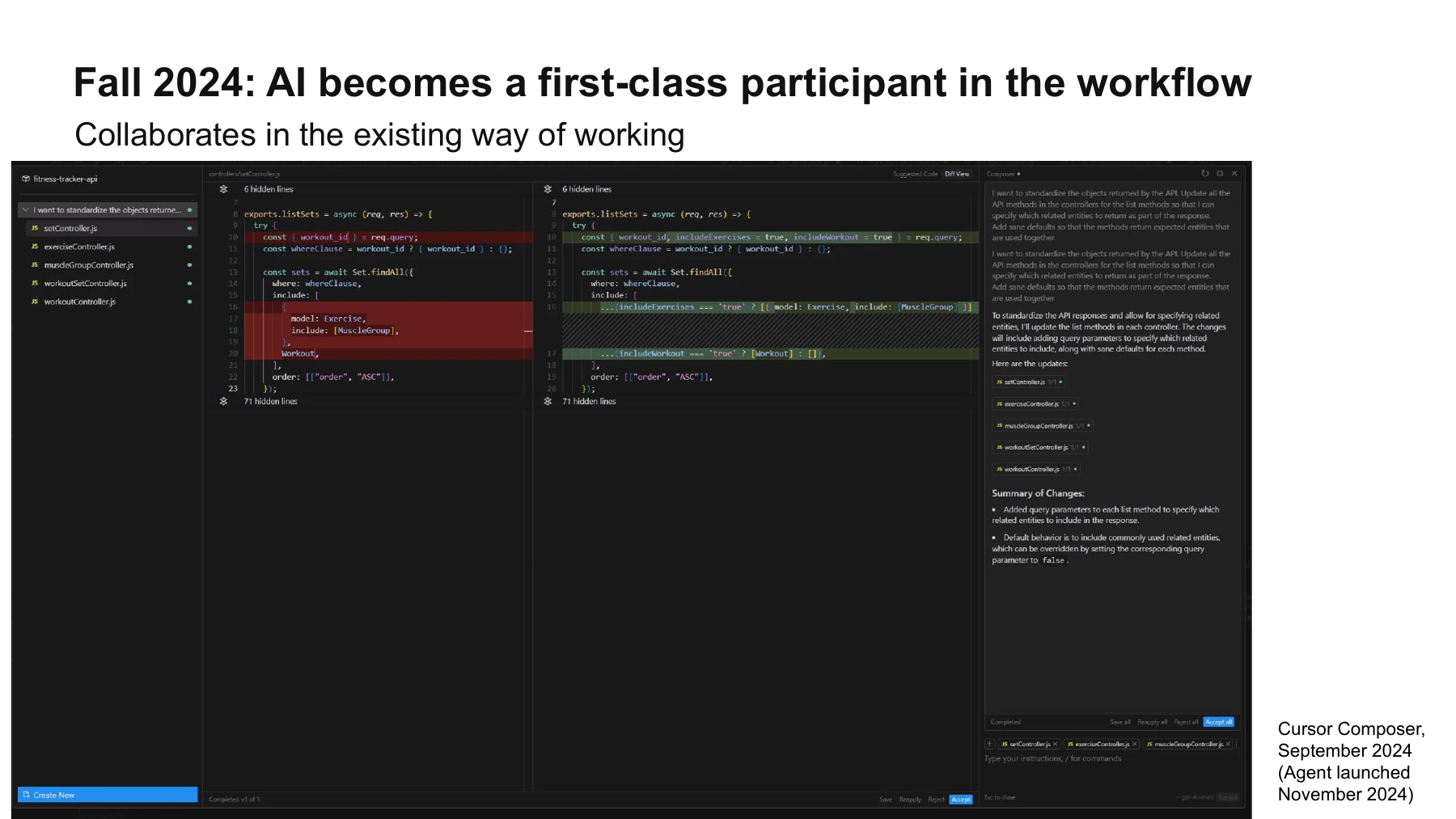
Fall 2024: Cursor Composer’s code diffs and chat illustrate AI collaborating within the programming workflow.
Slide 6 of 26
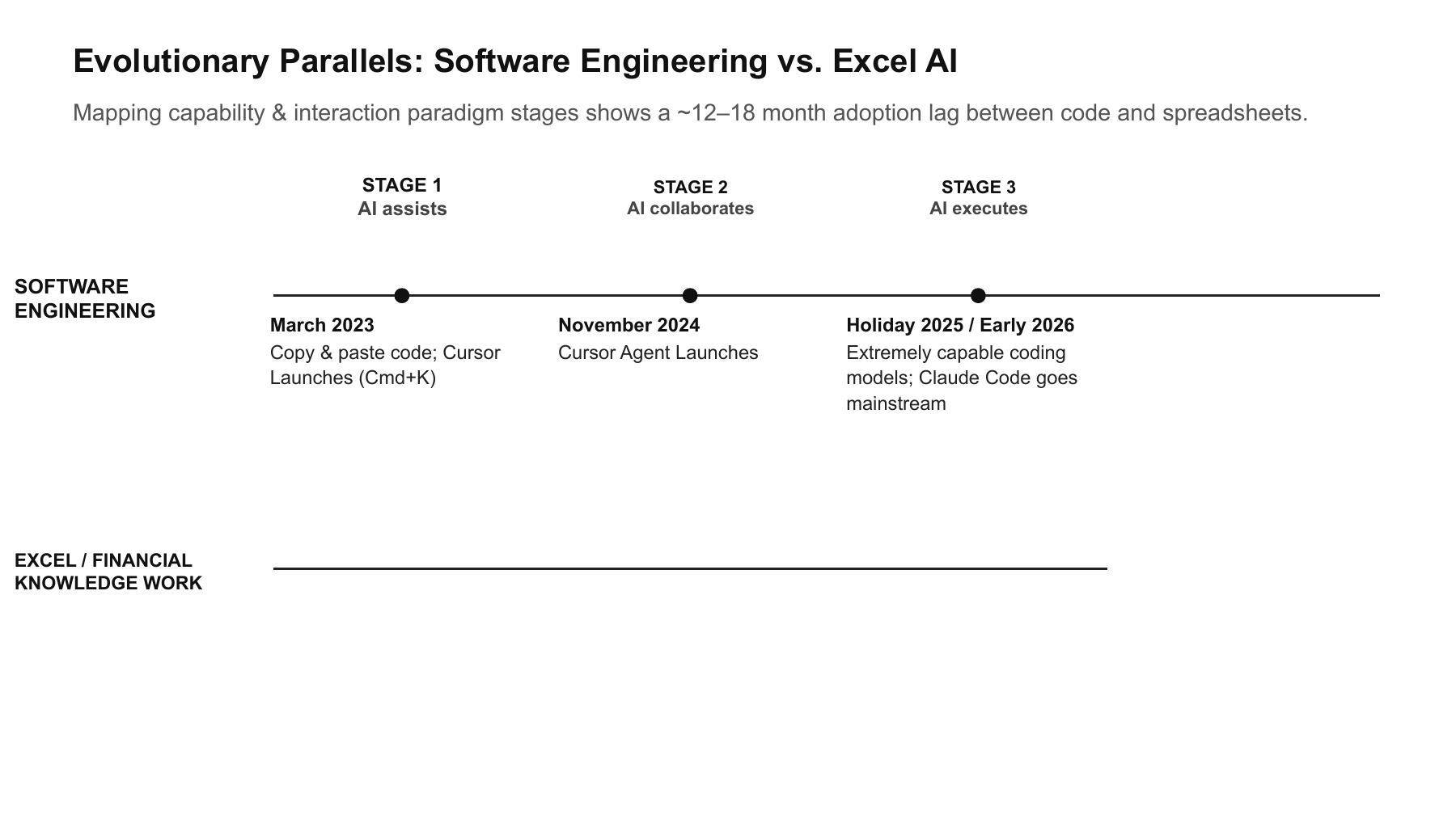
Timeline adds stage 3, AI executes: highly capable coding models and mainstream Claude Code adoption in late 2025 and early 2026.
Slide 7 of 26
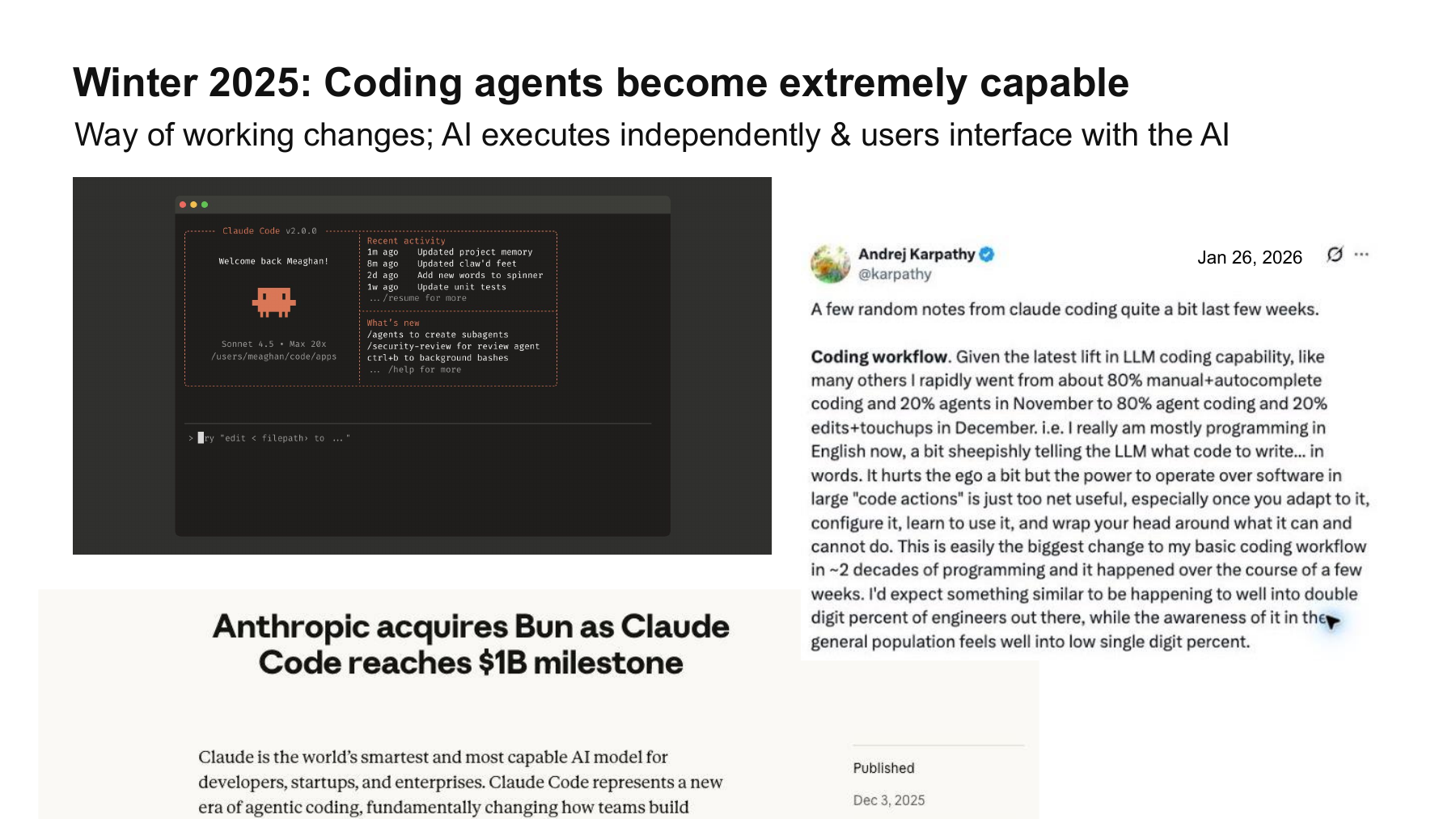
Winter 2025: Claude Code, an Anthropic headline, and an Andrej Karpathy post illustrate a shift toward agents executing independently.
Slide 8 of 26
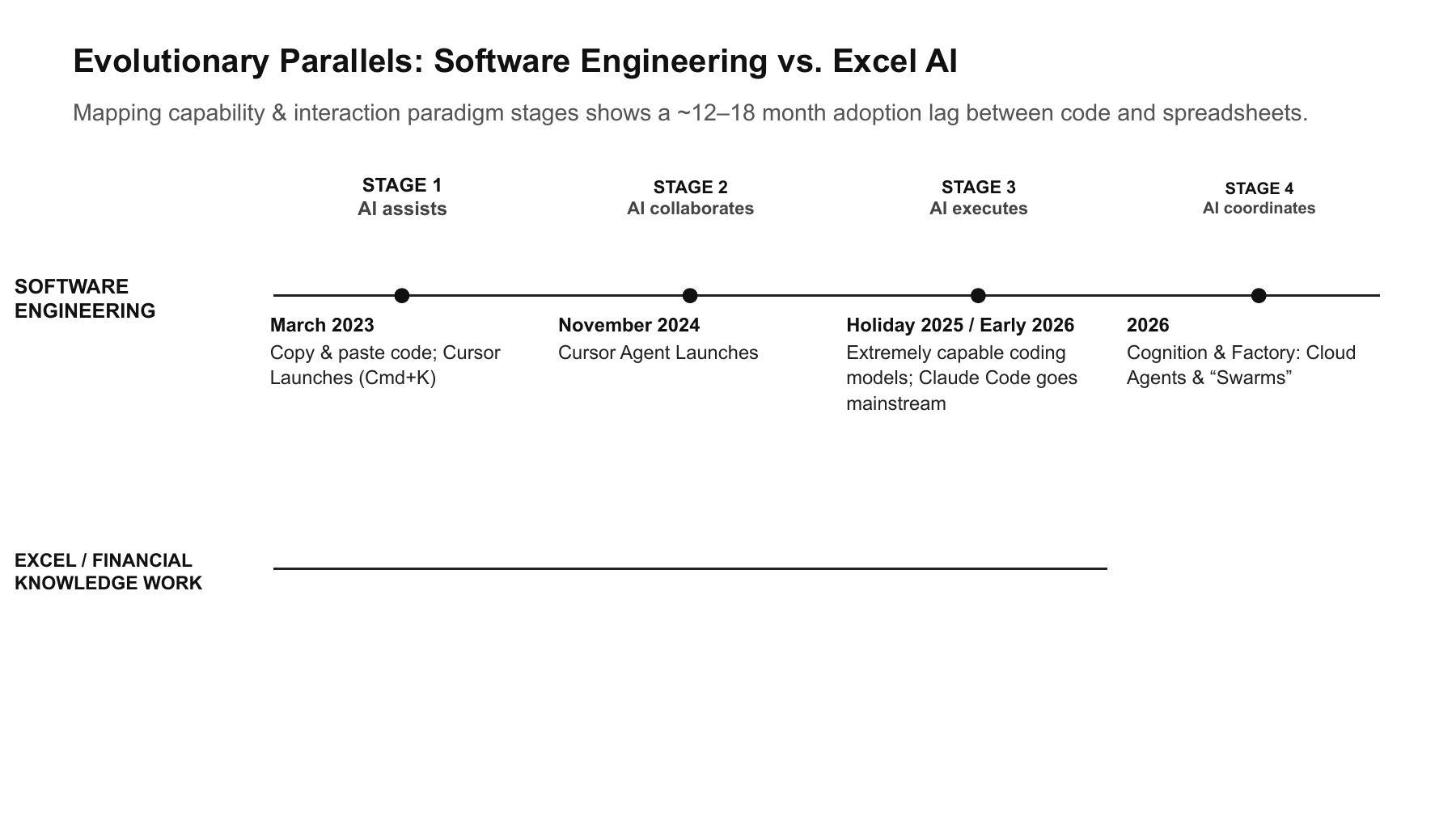
Timeline adds stage 4, AI coordinates: Cognition and Factory cloud agents and swarms in 2026.
Slide 9 of 26
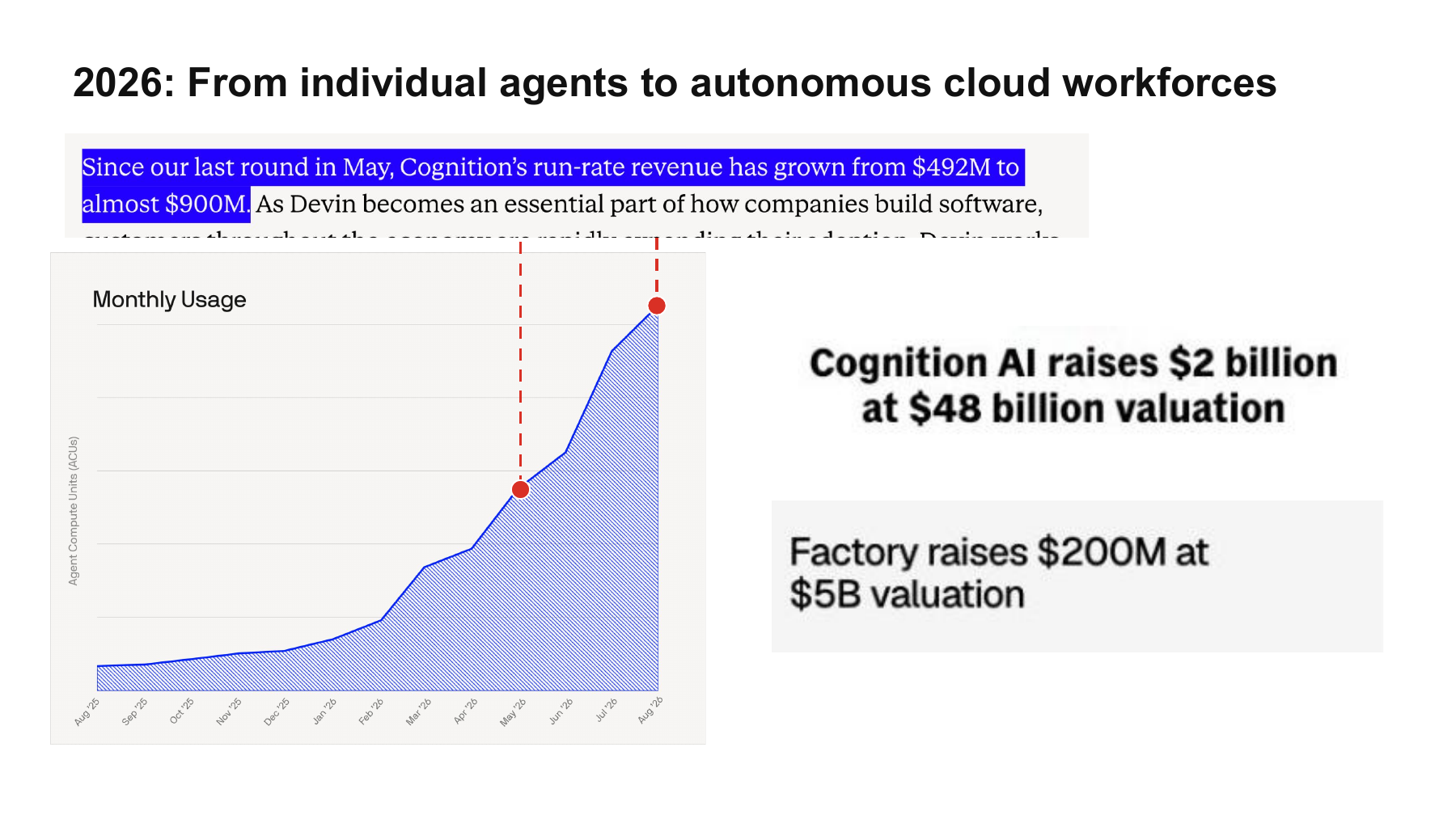
A rising monthly usage chart and Cognition and Factory headlines illustrate the 2026 shift toward autonomous cloud workforces.
Slide 10 of 26
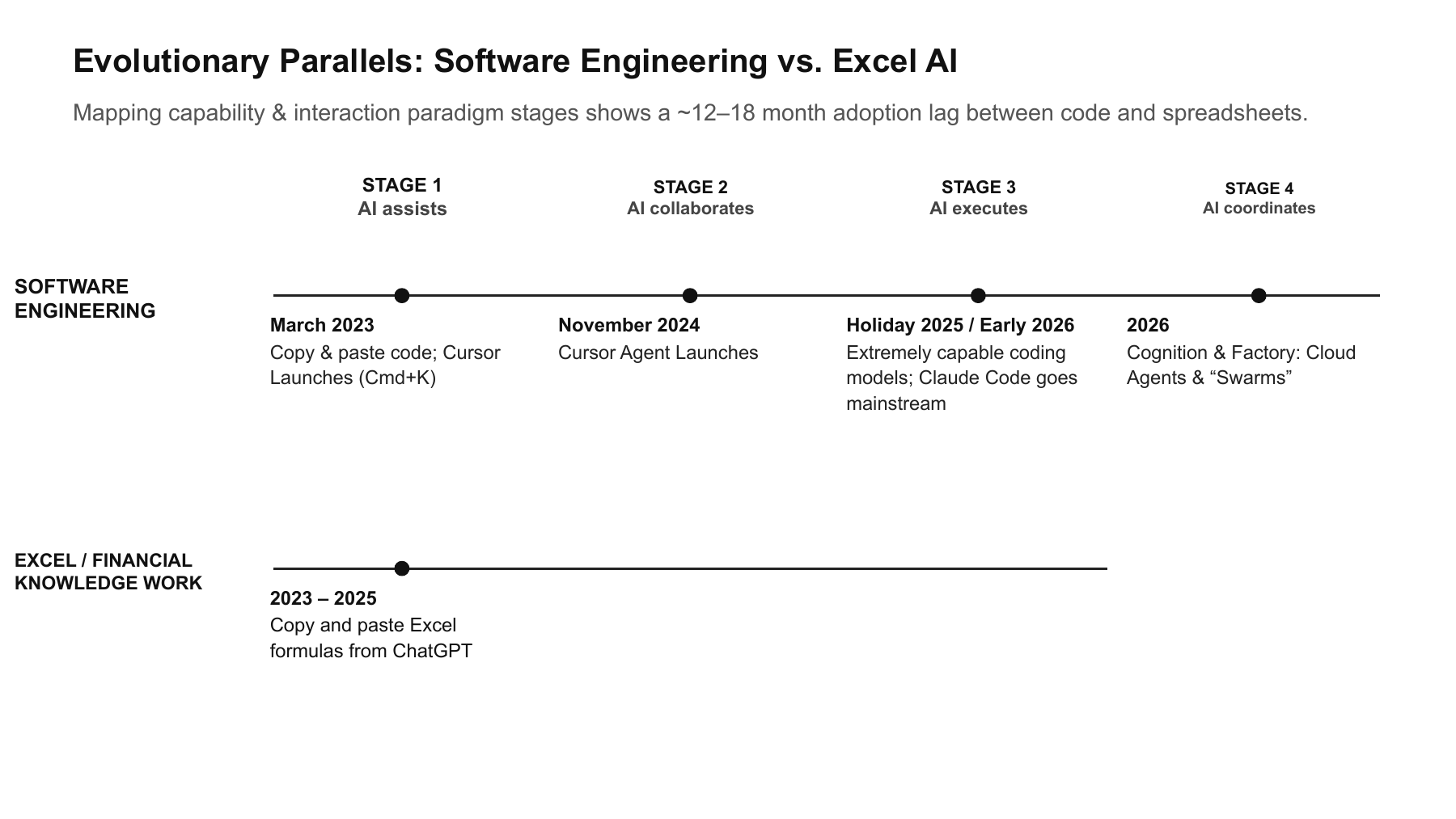
Timeline adds Excel’s first stage: copying and pasting formulas from ChatGPT during 2023–2025.
Slide 11 of 26
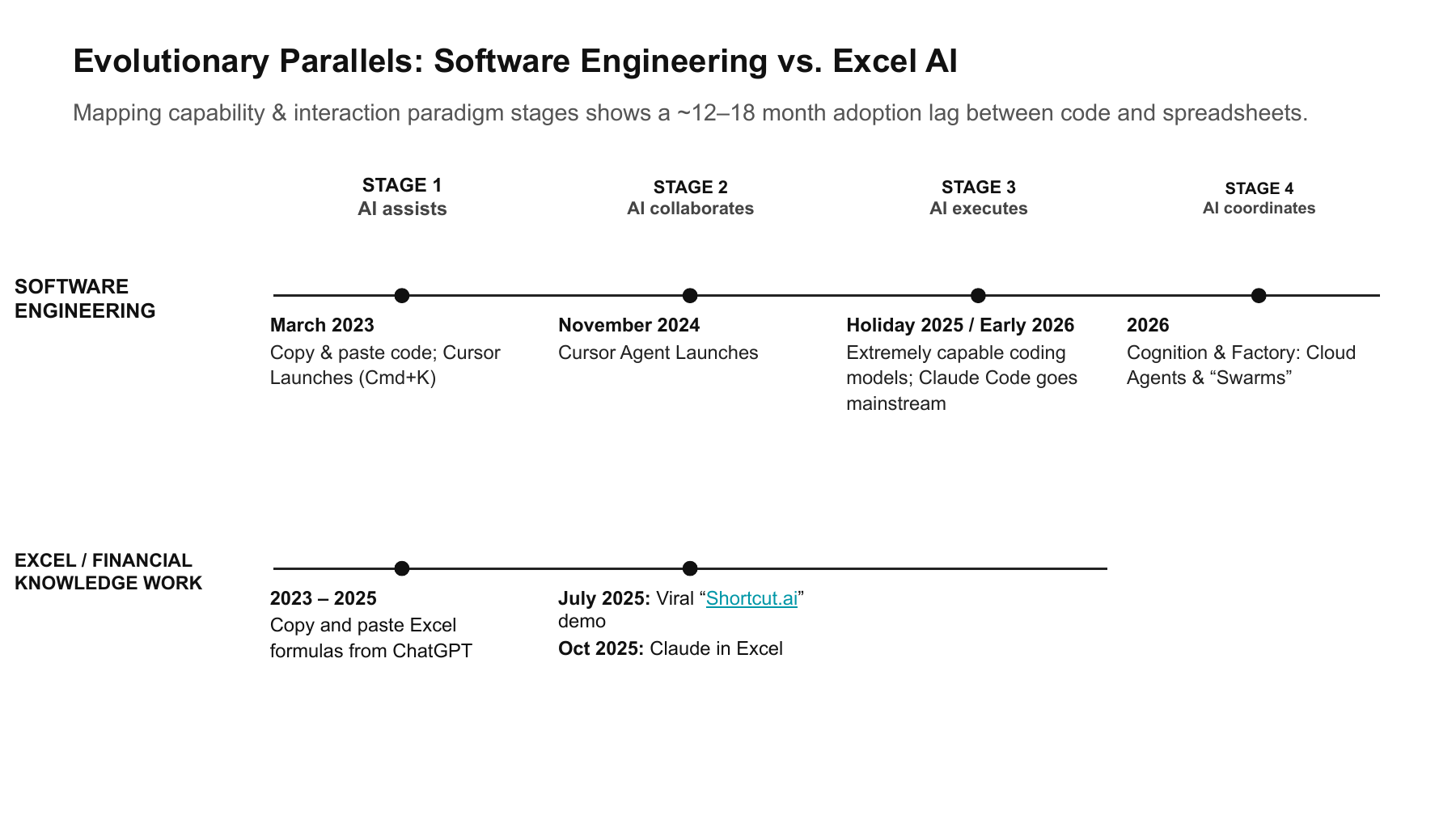
Timeline adds Excel’s collaboration stage, showing Shortcut’s July 2025 demo and Claude in Excel in October 2025.
Slide 12 of 26
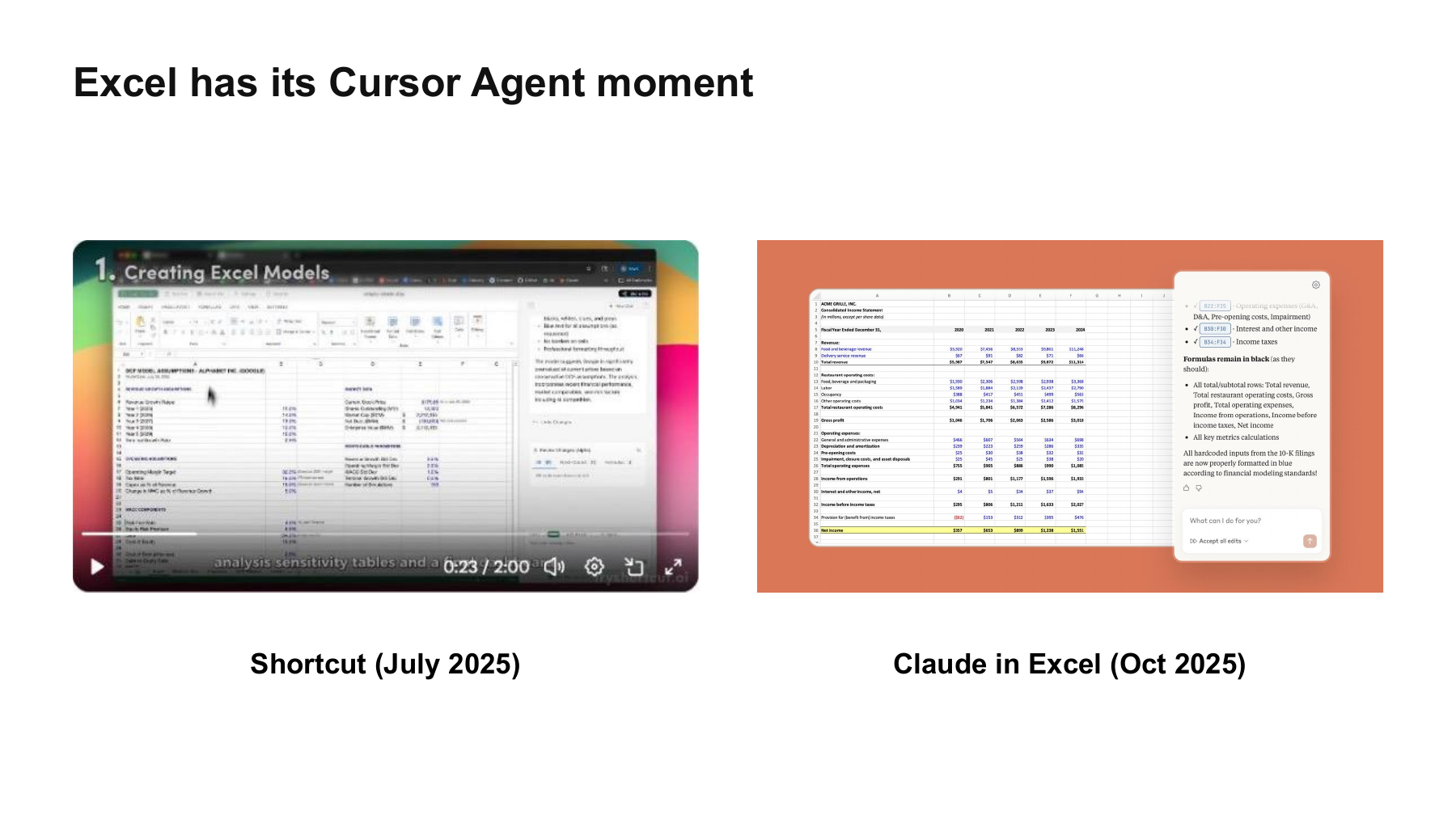
Excel’s Cursor Agent moment: side-by-side screenshots of Shortcut and Claude in Excel.
Slide 13 of 26
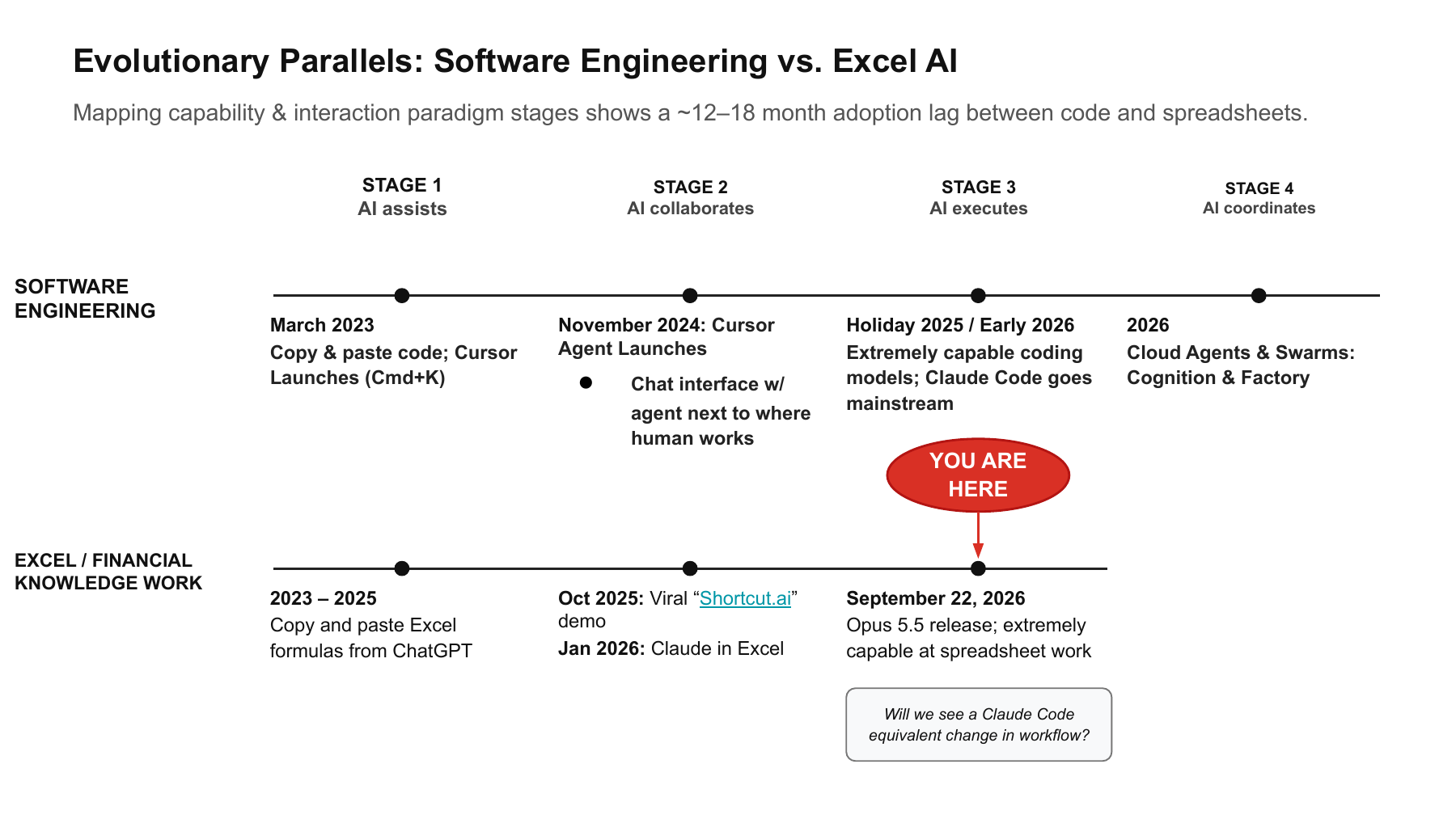
Four-stage timeline comparing software engineering and Excel AI, marking financial knowledge work at the transition toward independently executing agents.
Slide 14 of 26
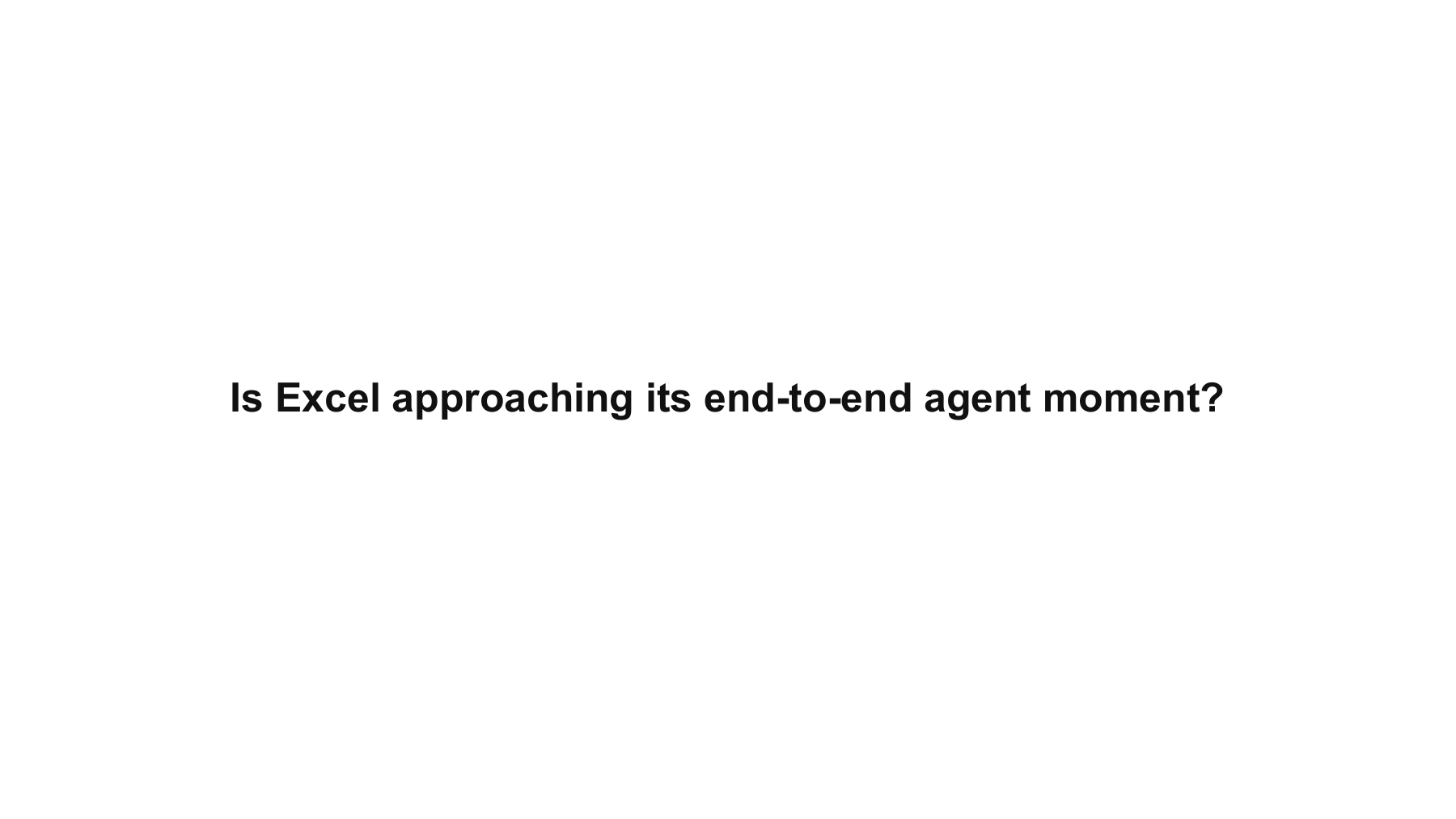
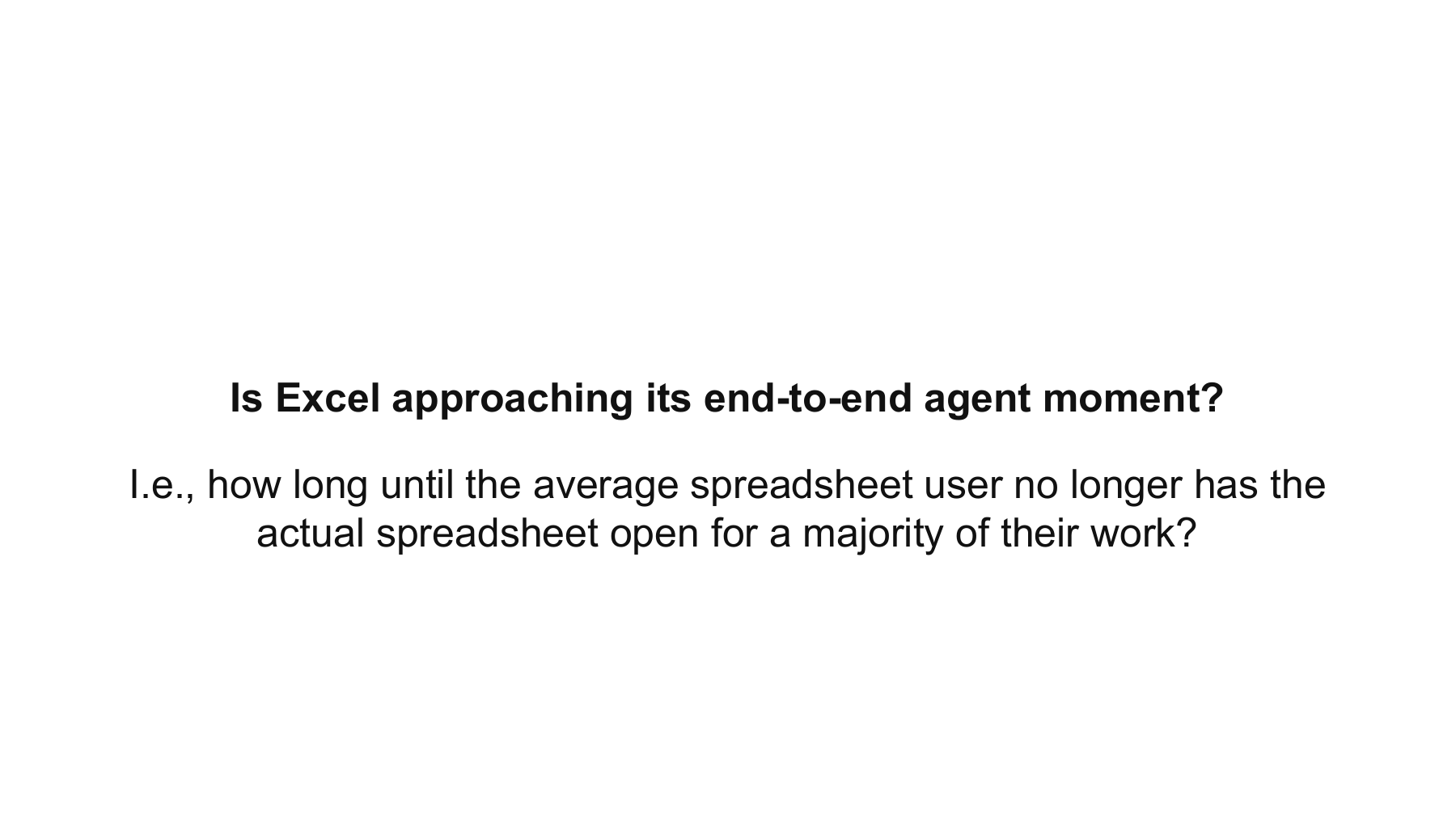
Is Excel approaching its end-to-end agent moment?
Slide 15 of 26
How long until spreadsheet users spend most of their work without the actual spreadsheet open?
Slide 16 of 26
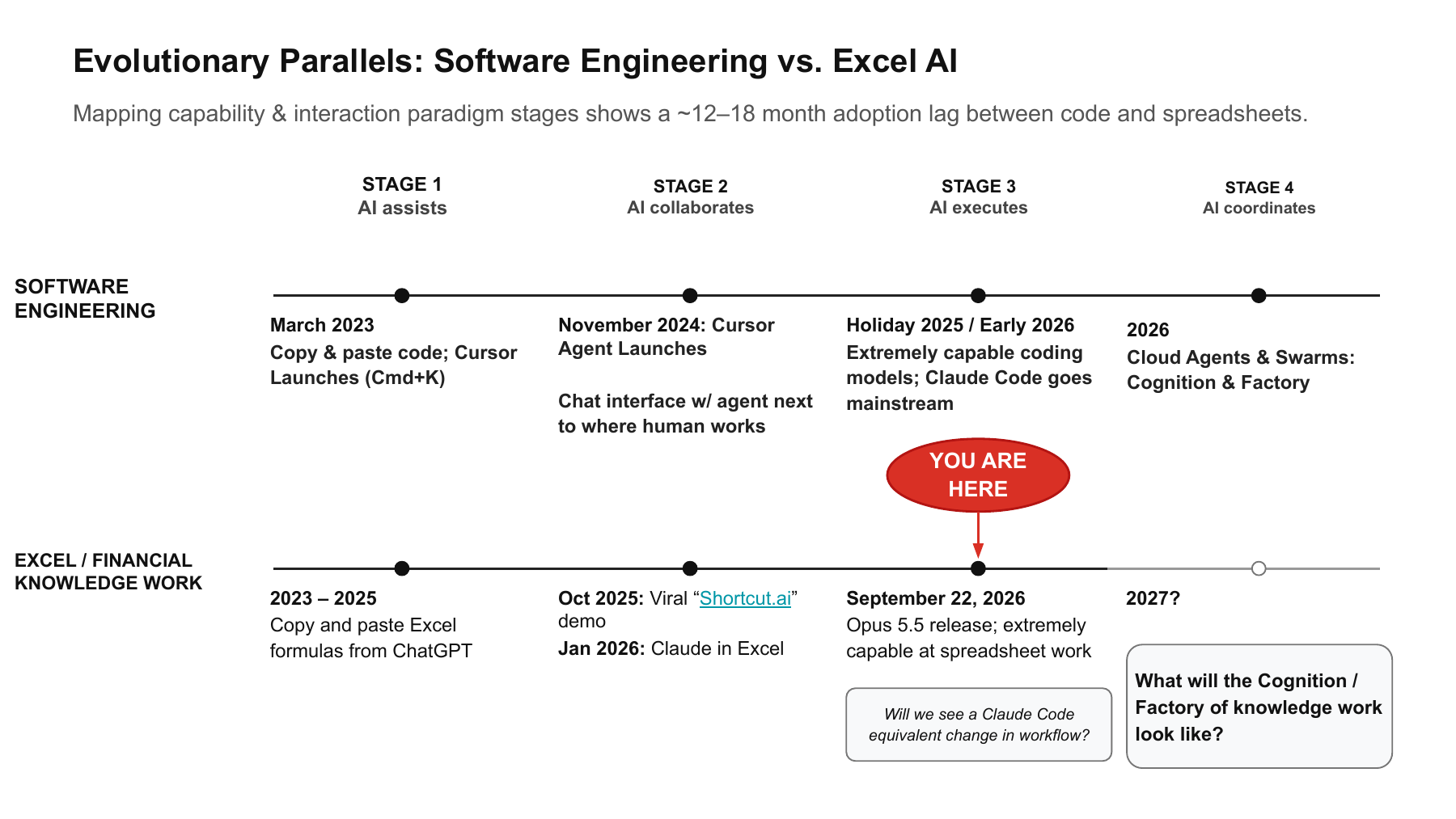
Timeline adds a possible 2027 coordination stage and asks what a Cognition or Factory equivalent for knowledge work will look like.
Slide 17 of 26
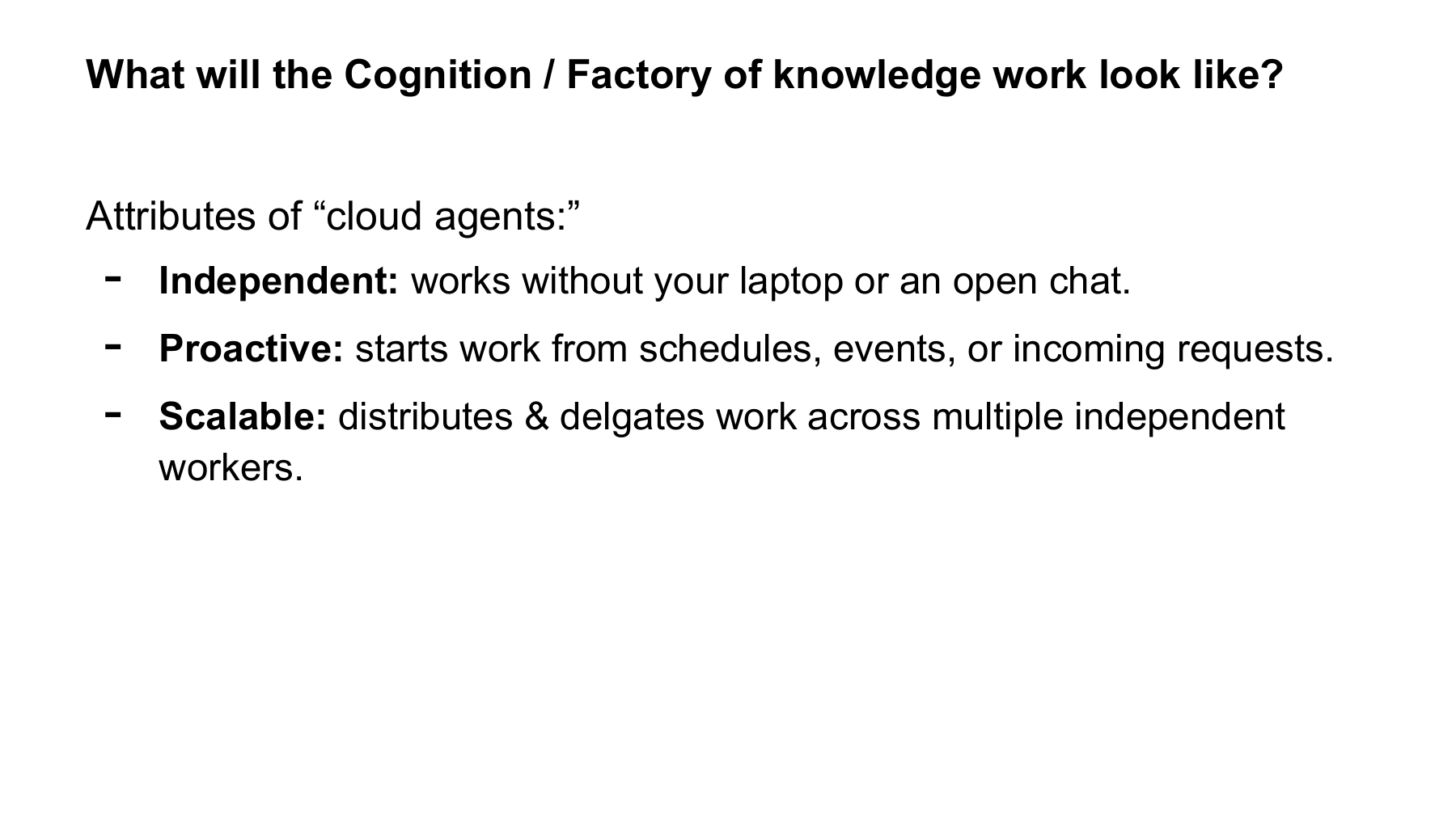
Cloud agents are independent, proactive, and scalable: they work without an open laptop, respond to triggers, and delegate across workers.
Slide 18 of 26
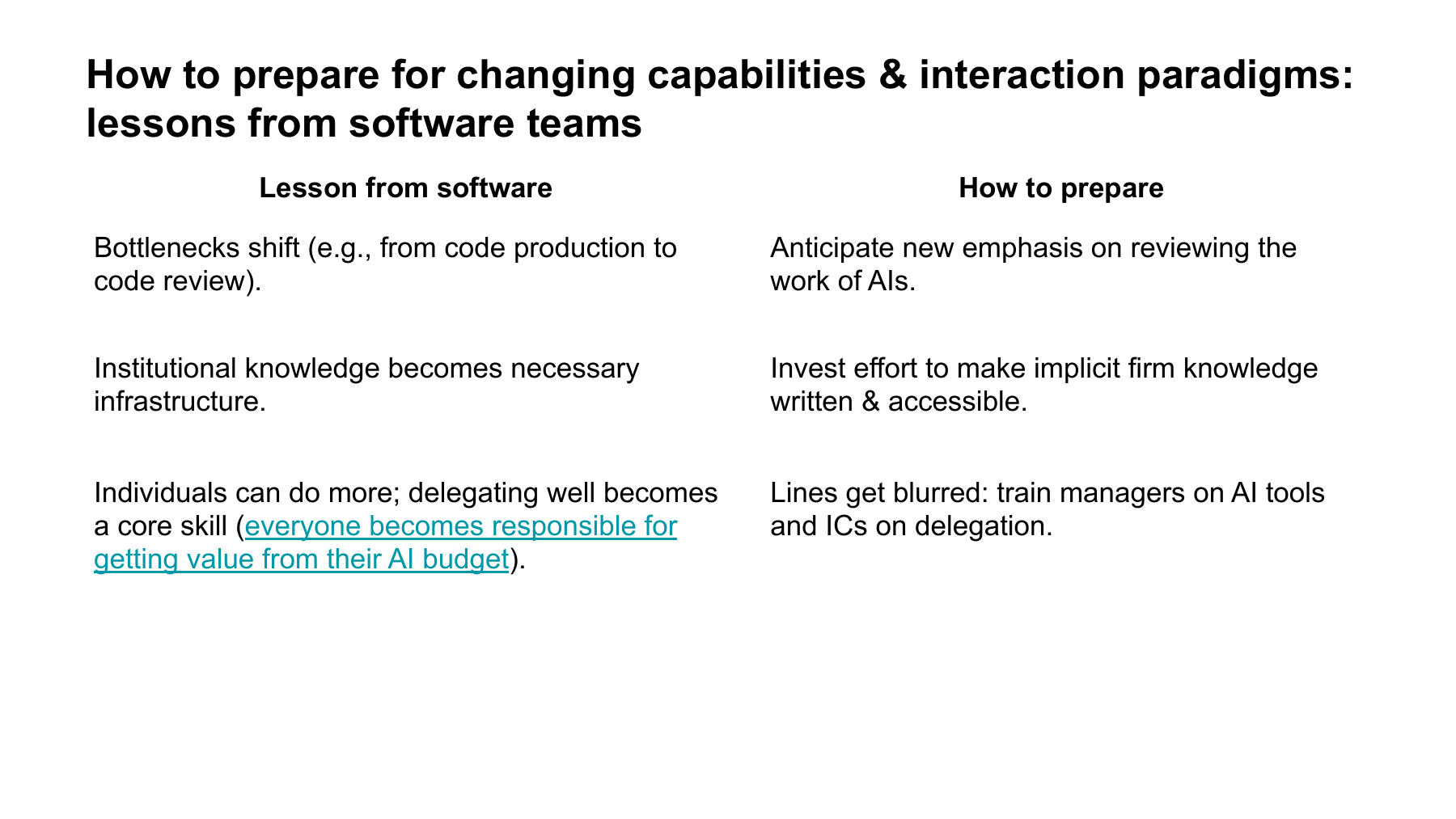
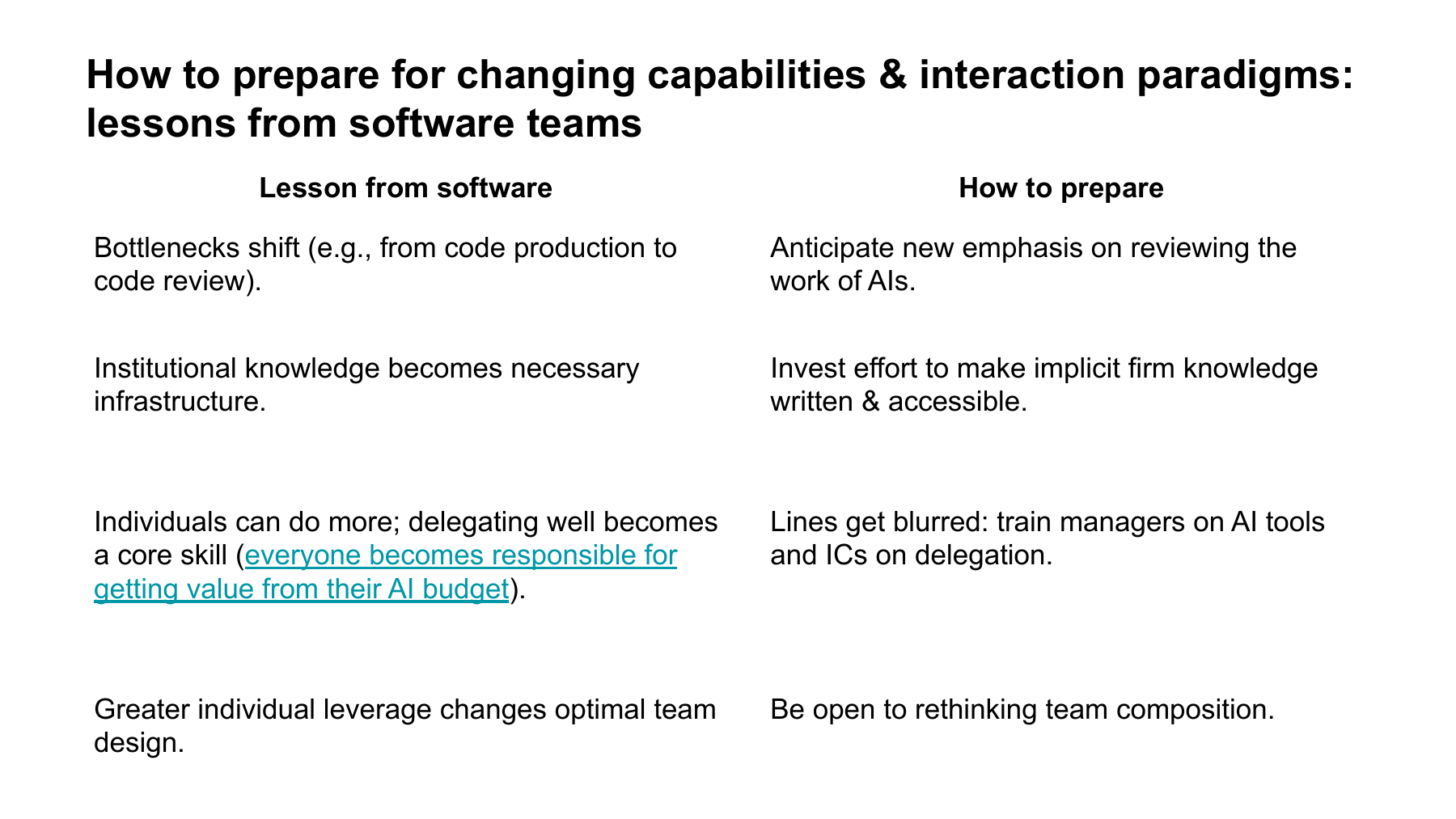
A two-column table pairs lessons from software teams with ways finance teams can prepare.
Slide 19 of 26
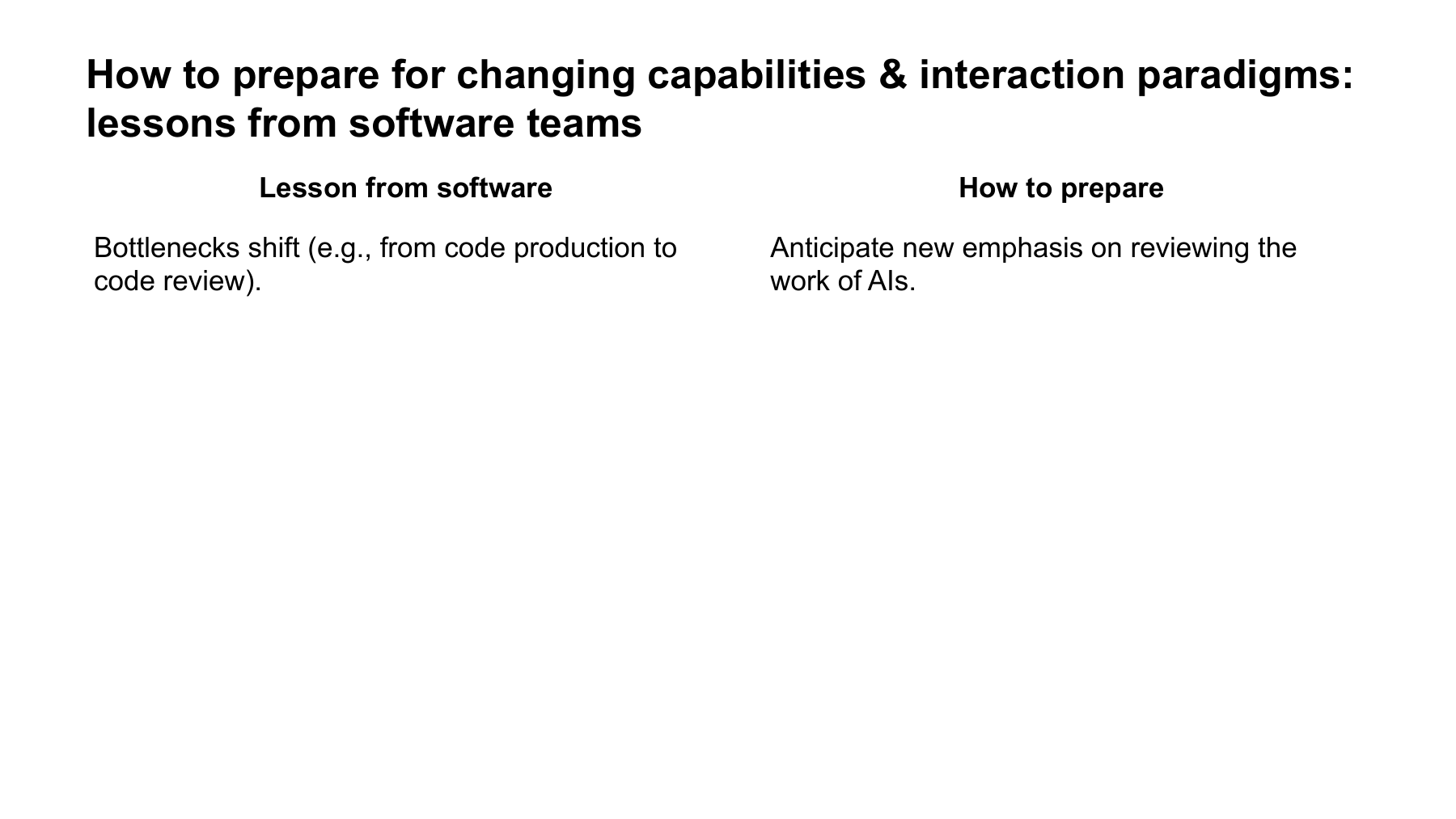
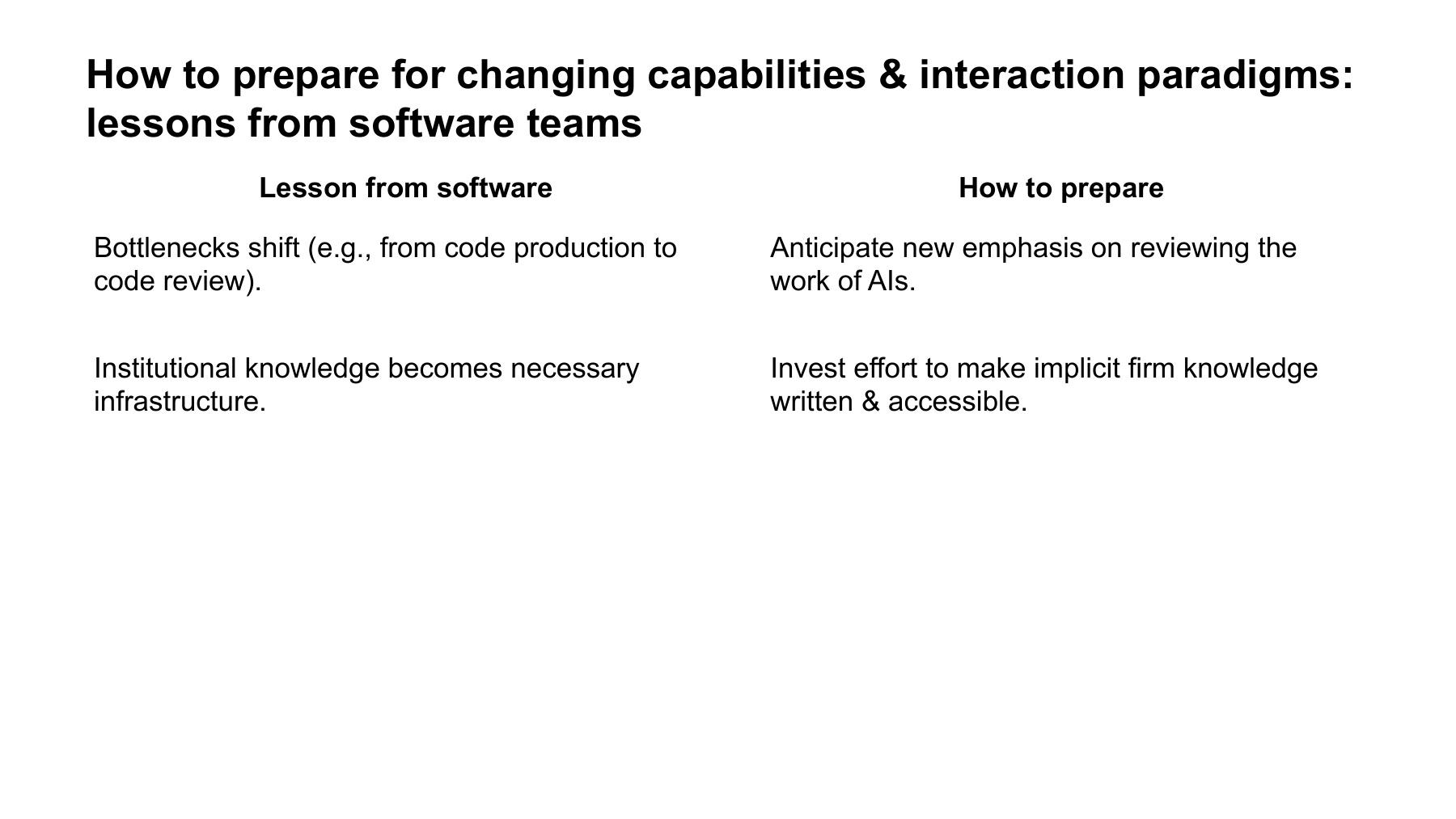
First lesson: bottlenecks shift from producing work to reviewing it, increasing the importance of reviewing AI outputs.
Slide 20 of 26
A second lesson: institutional knowledge becomes infrastructure, so firms should document implicit knowledge and make it accessible.
Slide 21 of 26
A third lesson: delegation becomes a core skill; train managers on AI tools and individual contributors on delegation.
Slide 22 of 26
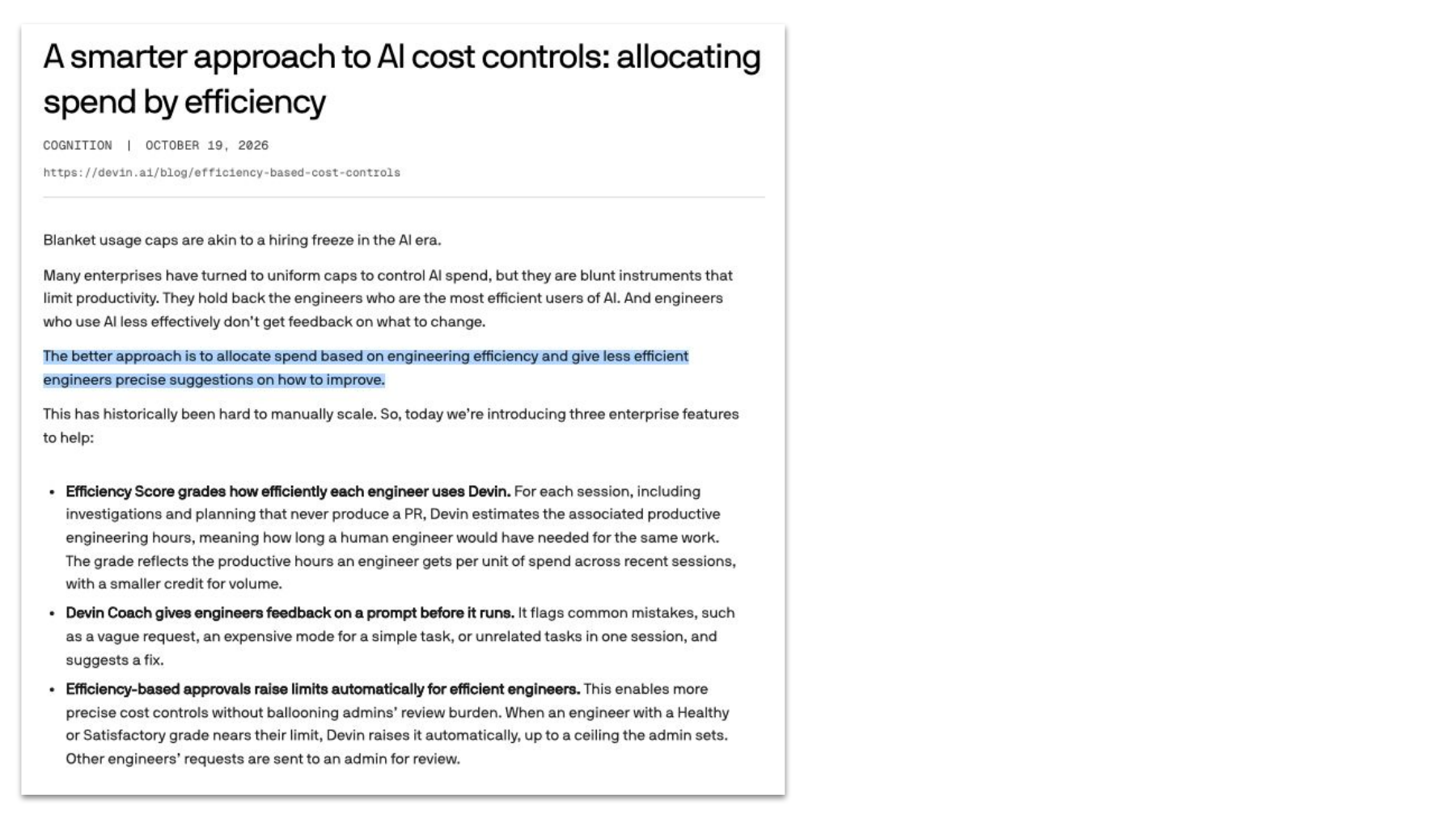
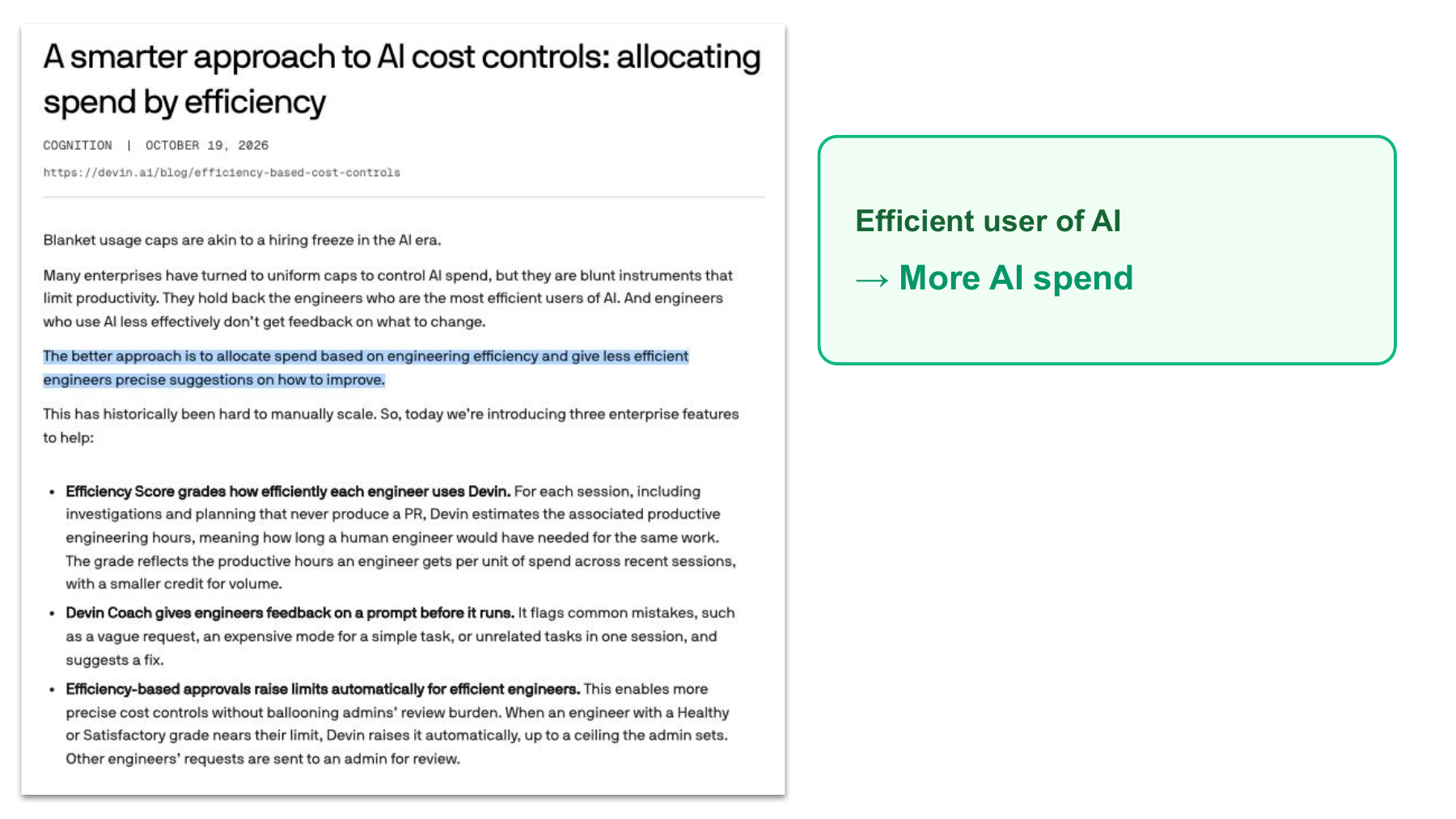
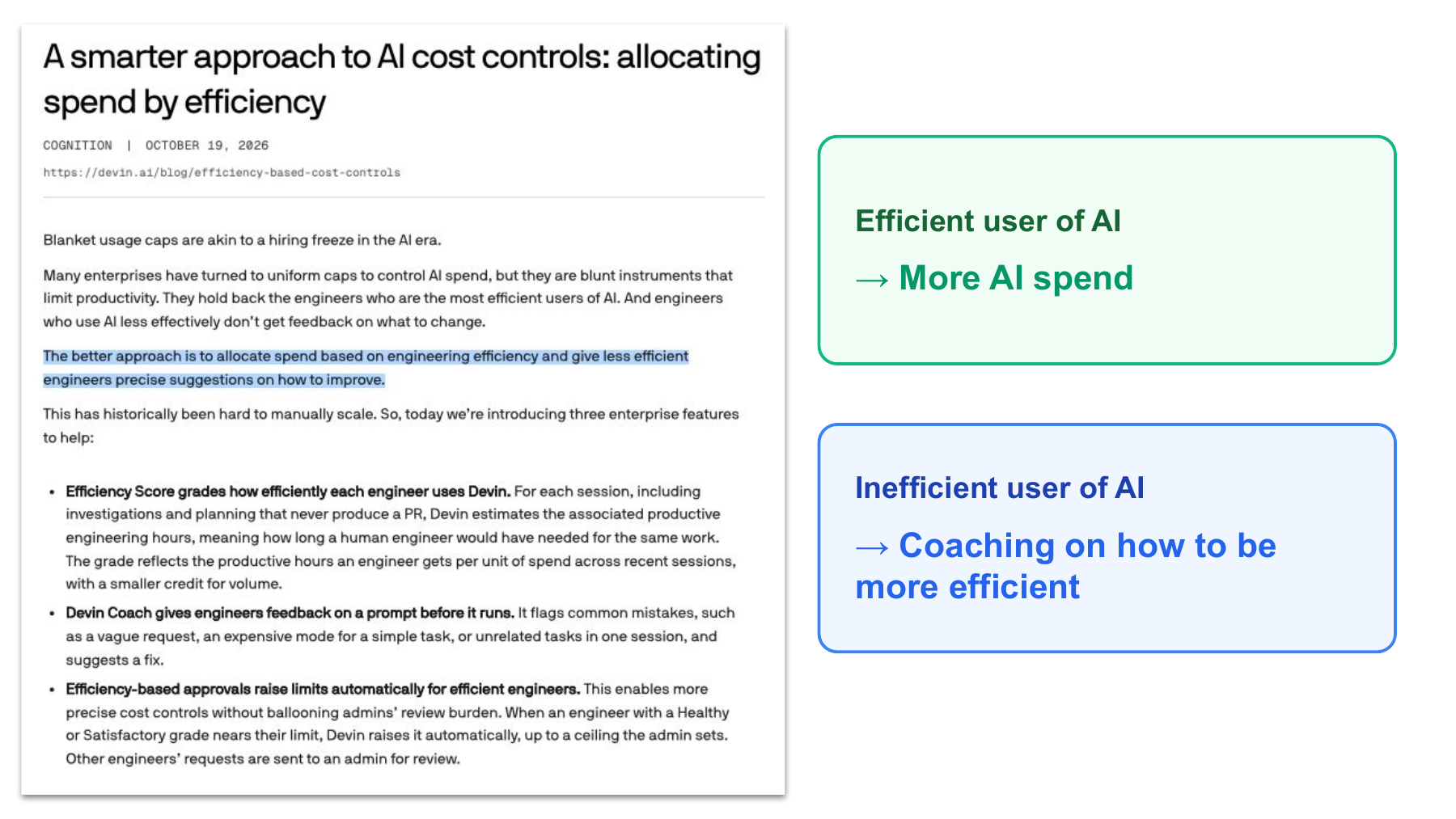
Screenshot of Cognition’s article on allocating AI spending by efficiency, with guidance to reward efficient users and coach others.
Slide 23 of 26
A green callout beside the article says efficient AI users should receive more AI spending.
Slide 24 of 26
A blue callout says less efficient AI users should receive coaching to improve.
Slide 25 of 26
The preparation table adds a fourth lesson: greater individual capability changes team design, so reconsider team composition.
Slide 26 of 26